

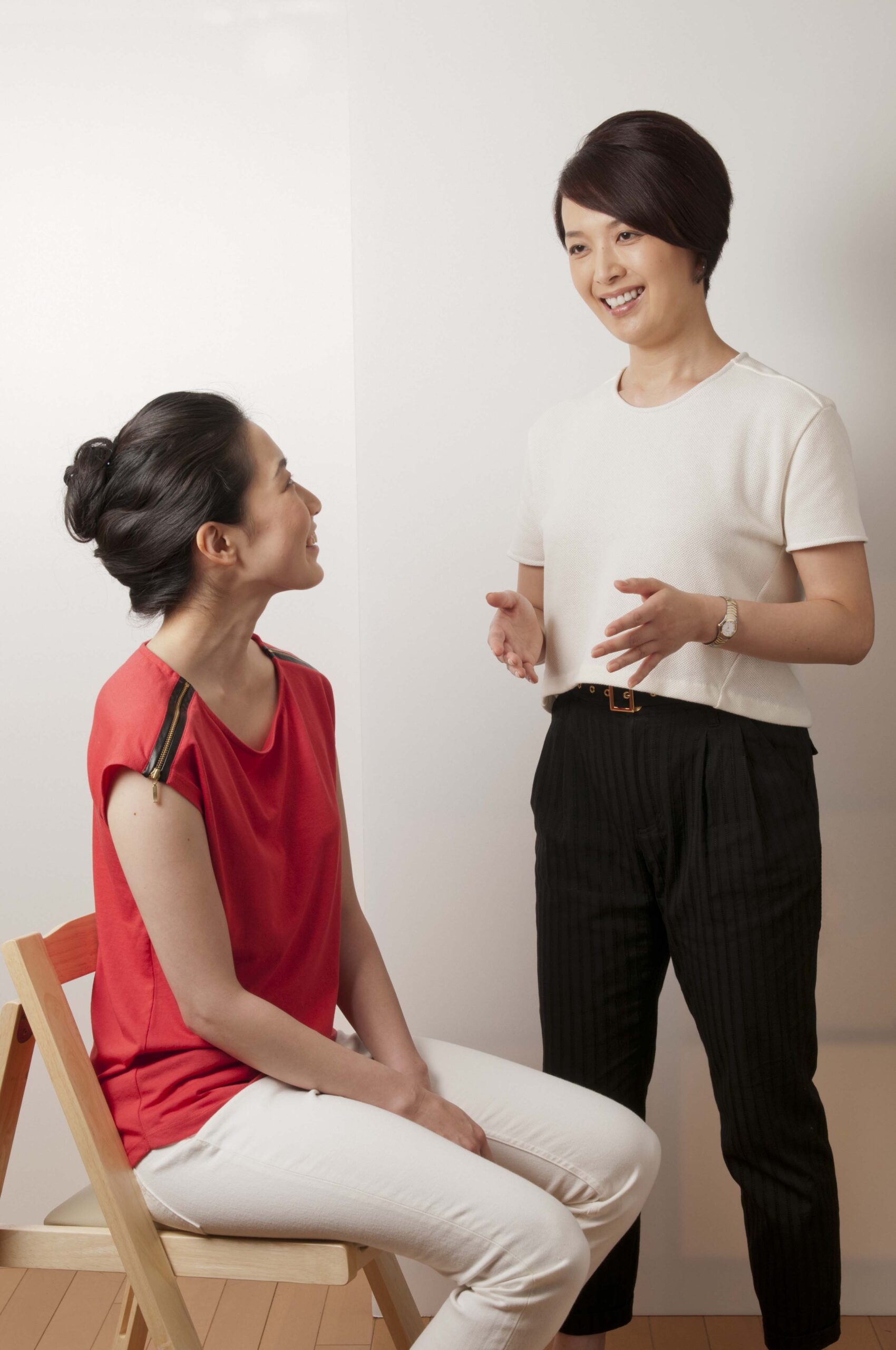
Does your neck tighten just before you sing? Do your shoulders rise when you speak, or does your breathing change the moment you step into an audition?
Perhaps you already know that you tend to use too much effort. You have tried relaxing, breathing more deeply or correcting your posture, yet the same physical response returns when you perform.
What if the more useful question is why you keep creating that tension in the first place?
I am Kaoru Kuwata, a STAT-certified Alexander Technique teacher, acting coach and movement specialist based in Tokyo. I offer private Alexander Technique lessons in English and Japanese, drawing on more than 20 years of experience working with actors, singers, dancers and other performers.
Lessons take place in Shimokitazawa, Tokyo, and explore how habitual responses influence movement, breathing, voice, attention and performance.
Alexander Technique in Tokyo: More Than Posture and Relaxation
Alexander Technique is frequently associated with good posture, relaxation and releasing muscular tension. These descriptions touch on aspects of the work, but leave out something essential.
The Technique is concerned with how we use ourselves in activity, including the relationship between intention, attention, habitual responses and movement.
When we decide to do something, we often begin preparing physically before the action itself. A singer anticipating a high note may tighten the neck or jaw. An actor preparing for an emotionally demanding scene may hold their breath or brace their shoulders before speaking.
Over time, these responses can become so familiar that they feel necessary, even when they interfere with what we want to achieve.
One of the central principles of Alexander Technique is inhibition: learning to prevent an automatic habitual response, allowing space for a different choice. Another important aspect is direction, concerned with how we consciously guide and organise our use of ourselves.
We are not trying to manufacture an ideal posture or eliminate all muscular effort. Movement, singing and acting require activity. The question is whether the effort we make is useful, necessary and appropriate to what we want to do.
Why Does Habitual Tension Return When You Perform?
You might move freely during an ordinary conversation but become physically restricted when presenting a speech. You may sing comfortably in rehearsal, only to find that your breathing and coordination change when the stakes are higher.
These patterns are sometimes difficult to identify because our sensory awareness is influenced by habitual use. What feels natural or correct may simply be familiar.
Trying harder to relax can itself become another form of effort. Similarly, concentrating on taking a bigger breath may unintentionally interfere with the coordination required for speaking or singing.
Before asking how to produce a better sound or a more expressive movement, it can be useful to notice what you are already doing in preparation.
Are you tightening somewhere before you begin? Are you anticipating the result? Are you organising your body around an expected difficulty rather than responding to what is actually happening?
These questions are particularly relevant to performers because habits often become more noticeable under pressure.
Performance is not a laboratory. The aim is to develop awareness and choice that remain useful when rehearsing, auditioning, performing or responding to an unexpected situation.
What Happens During a Private Alexander Technique Lesson?
Private Alexander Technique lessons involve observation, movement, practical exploration and individual feedback.
We may begin with ordinary activities such as standing, sitting, walking, turning or speaking. Simple movements can reveal habitual preparations that are harder to observe during complex performance tasks.
Depending on your goals, we can also explore activities related to your professional work, such as speaking a passage of text, singing a phrase, moving through space or preparing to perform.
Rather than asking you to imitate a particular shape, I help you notice what happens as you initiate and carry out an activity. We examine how your attention, expectations and habitual muscular responses affect what you do.
The intention is for you to develop an increasingly reliable understanding of your own habits and the choices available to you, including when practising independently.
Hands-on Guidance: Learning Through Movement and Experience
Hands-on guidance is an important part of my Alexander Technique teaching.
I may use gentle, purposeful contact to guide movement, help you recognise unnecessary muscular effort and explore different ways of coordinating the body.
This can be particularly useful when a habitual pattern feels so normal that verbal instructions alone are insufficient to make it recognisable.
Hands-on work is not massage, manipulation or medical treatment. Its purpose is educational: to help you observe, experience and learn about how you use yourself.
Physical contact is explained beforehand and takes place with your consent. We can also explore activities through verbal guidance, observation and discussion, taking your preferences and circumstances into account.
Ultimately, the learning needs to belong to you. The goal is to become better able to recognise your own patterns and make choices without depending on a teacher to correct you.
Alexander Technique for Actors: Habitual Tension and Physical Choices
Actors often become highly skilled at creating specific physical and emotional responses. Yet the body may also repeat familiar patterns that have little to do with the character or the circumstances of the scene.
Perhaps you tense your jaw whenever you need to communicate anger. You may prepare an emotional moment by holding your breath, or fix your posture because you want to appear confident.
Physical tension can, of course, be a deliberate expressive choice. A character may need to struggle, resist, hold back or exert considerable effort.
The important distinction is whether you have chosen that physical response for the character, or whether your own familiar habit has already made the decision for you.
Alexander Technique offers an opportunity to investigate these responses, leaving more room for different actions, relationships and expressive possibilities.
For actors who repeatedly encounter the same physical limitations across different roles, this can be a valuable part of ongoing professional training.
Alexander Technique for Singers: Breathing, Voice and Unnecessary Effort
Singing places complex demands on breathing, coordination, attention and movement.
Some singers notice that they brace the torso before a difficult phrase, tighten the neck when anticipating a high note or increase muscular effort when they want greater volume.
These responses can become closely associated with singing itself. Even when a singer understands the problem intellectually, the familiar response may return as soon as the music begins.
Alexander Technique offers a way to explore the relationship between intention, breathing, movement and the use of the voice, without treating a single part of the body in isolation.
This work can complement singing lessons and vocal training. It does not replace a singing teacher’s specialist technical instruction or appropriate medical care for a voice condition.
A Singer’s Experience: Discovering the Difference Between Releasing Tension and Simply Relaxing
An opera singer in her 30s who attended my private Alexander Technique lessons described how her understanding of physical effort changed through the work.
She had originally sought lessons because she noticed that she often braced her entire body while singing opera and wondered whether this was creating unnecessary tension.
“Even in everyday movements, I had habitual ways of using my whole body, so we began by recognising those habits. Through simple movements, Kaoru pointed out precisely when I was using more effort than necessary, which parts of my body I unconsciously relied on, and when I was restricting my own range of movement.”
As she explored movement and coordination, her understanding of what it meant to reduce unnecessary effort began to change.
“At first, I misunderstood the idea of removing excessive tension as simply relaxing and not using muscular effort. Gradually, I began to understand that she was teaching me how to use myself.”
She also described noticeable changes when applying the work while singing. Her singing teacher subsequently observed that she was using less unnecessary effort and developing a better sense of balance.
“Kaoru’s lessons are very clear because she teaches through actual movement, in a way that allows me to understand what is happening.”
Her experience illustrates an important distinction: becoming aware of unnecessary effort involves more than simply trying to relax. Learning to recognise how and when we interfere with an activity can create new possibilities for coordination.
Translated excerpts from an opera singer’s testimonial originally published in Japanese in 2020. These reflect her individual experience.
Read the original testimonial in Japanese.
Alexander Technique for Dancers, Musical Theatre Performers and Professional Speakers
Similar questions arise across different performance disciplines.
Dancers may notice unnecessary effort during transitions or changes of direction. Musical theatre performers may need to coordinate singing, movement and acting simultaneously. Voice actors and professional speakers may discover that vocal demands influence the way they organise the whole body.
Each discipline has its own technical requirements. Alexander Technique does not replace specialist training in dance, acting or voice, but it can offer another perspective on the habitual responses that accompany these activities.
Lessons can be adapted to your background, experience and the activities you wish to explore.
About Kaoru Kuwata: STAT-Certified Alexander Technique Teacher in Tokyo
I trained as an Alexander Technique teacher at the Hampstead Centre in London and am certified by the Society of Teachers of the Alexander Technique (STAT).
I also translated F. M. Alexander’s book The Use of the Self into Japanese. The translation, Jibun no Tsukaikata (『自分のつかい方』), was published by Bansei Shobo in 2010.
My background in the performing arts includes studying Drama and Theatre Arts at Goldsmiths, University of London, followed by postgraduate studies in Movement Studies at the Royal Central School of Speech and Drama.
For more than 20 years, I have worked with actors, singers, dancers and other performers in individual lessons, classes and professional training settings.
My teaching brings together Alexander Technique, movement studies, acting and voice-related training. I am particularly interested in how performers learn, how habitual patterns influence their work and how new understanding can become useful in actual performance.
I teach in both English and Japanese. For performers who use Japanese in daily life but prefer to explore detailed physical sensations and professional terminology in English, lessons can be conducted entirely in English.
You can read more about my professional background on my English profile page.
Private Alexander Technique Lessons in English — Shimokitazawa, Tokyo
Private Alexander Technique lessons are available in Shimokitazawa, Tokyo. Each session is tailored to your experience, professional background and the activities you wish to explore.
Private lesson fees:
- 90 minutes — ¥20,000
- 120 minutes — ¥35,000
Studio rental fees are charged separately. The appropriate studio and its rental cost will be confirmed when arranging your lesson.
The 90-minute session provides time to examine your current habits and work practically with movement, breathing, voice or another relevant activity. A 120-minute session allows more time to explore several related activities in greater depth.
In-person lessons are the primary format, particularly where hands-on guidance is important. Online lessons may be considered in specific circumstances, such as living outside Tokyo or being unable to travel for in-person work. Hands-on guidance is available only during in-person lessons.
For general information about my other services, please see the classes and private lessons page (in Japanese).
Alexander Technique or Acting Coaching: Which Lesson Should You Book?
Alexander Technique and acting coaching are different forms of study, although they can inform one another.
Alexander Technique focuses on habitual responses, coordination, attention, breathing, movement and how you use yourself during activity.
Acting coaching focuses more directly on scripts, roles, objectives, relationships, auditions and the demands of acting in theatre or on screen.
If your main interest is understanding habitual tension or developing greater choice in how you move, breathe, speak or sing, Alexander Technique may be the appropriate starting point.
If you need to prepare a scene, investigate a character or work on a specific audition, acting coaching may be more relevant.
Because I teach in both fields, the most appropriate form of work can be identified according to your goals, without treating the two services as interchangeable.
Frequently Asked Questions About Alexander Technique Lessons in Tokyo
Can I take Alexander Technique lessons entirely in English?
Yes. Private lessons can be conducted entirely in English, in Japanese or bilingually, depending on your needs.
Do I need previous experience with Alexander Technique?
No. Lessons can be adapted to your current experience and interests.
What happens during my first Alexander Technique lesson?
We begin by discussing what you would like to investigate. Through observation and practical activities such as standing, sitting, walking or speaking, we explore your habitual responses. Activities related to singing, acting or movement may also be included when appropriate.
Do Alexander Technique lessons include hands-on guidance?
Yes. Hands-on guidance is part of my teaching. It helps you explore movement, coordination and unnecessary muscular effort. The nature of physical contact is explained and your consent is sought beforehand.
How much are private lessons and where do they take place?
Private lessons take place in Shimokitazawa, Tokyo. A 90-minute lesson costs ¥20,000, and a 120-minute lesson costs ¥35,000. Studio rental fees are additional.
Can I combine Alexander Technique with acting or singing?
Yes. We can explore activities related to your professional practice within an Alexander Technique lesson. Specialist acting coaching is also available separately when your main objective involves scripts, roles or auditions.
Book a Private Alexander Technique Lesson in English in Tokyo
If you are looking for an English-speaking Alexander Technique teacher in Tokyo who also understands the demands of acting, singing, movement and performance, I welcome your enquiry.
Whether you are preparing for a production, investigating a persistent physical habit or looking to develop a more informed approach to your own practice, we can begin with what is relevant to your work.
When contacting me, please mention “Alexander Technique private lessons in English” and include your professional background, what you would like to work on and your preferred lesson duration of 90 or 120 minutes.
Enquire About Private Alexander Technique Lessons in Tokyo
Private lessons are arranged individually, subject to availability.
Apply for a Private Alexander Technique Lesson in Tokyo
To enquire about private Alexander Technique lessons in English, please complete the form below.
Please mention “Alexander Technique in English”, your preferred lesson duration (90 or 120 minutes), your professional background and what you would like to work on.
If the form does not appear, please open the enquiry form directly.

演技コーチ/ムーヴメント指導・演出・振付/IDC認定インティマシーディレクター/STAT認定アレクサンダー・テクニーク指導者/スピーチ&プレゼンテーションコーチングActing Coach/Movement Direction/IDC qualified Intimacy Director/STAT certified Alexander Technique teacher, mSTAT, Movement Teaching/Speech and Presentation Coaching